 Jessica
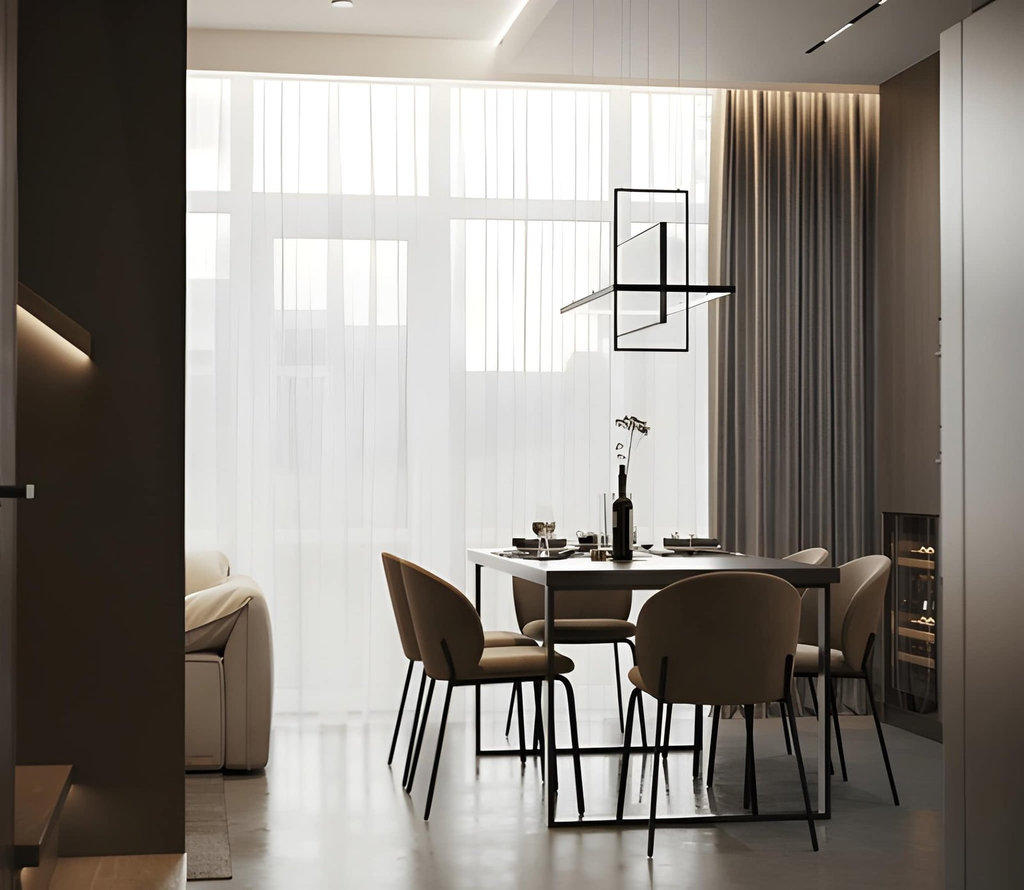
A dining room can have the right table, the right chairs, the right paint color — and still feel wrong at dinner. Nine times out of ten, the lighting is why.
Dining room lighting is one of the most mishandled decisions in American homes. Builders install a single flush-mount ceiling fixture centered on the room rather than the table. Homeowners add a chandelier at the wrong height. Someone puts in cool-white bulbs that make food look unappetizing and skin tones look flat. The room never quite feels like a place people want to linger.
What kind of lighting makes a dining room feel right isn’t complicated — but it involves more than choosing a fixture you like the look of. It’s about fixture type, hanging height, bulb temperature, layering, and how all of those interact with the size and shape of your specific table.
This guide covers every variable: which fixture types work, how low to hang them, what bulb temperature to use, and how to build a layered lighting setup that makes the dining room feel genuinely inviting rather than just adequately lit.
Why Most Dining Room Lighting Feels Off
The core problem in most American dining rooms is a single overhead source positioned too high, lit with the wrong bulb temperature, and operating without any supplementary light sources.
| Common Mistake | What It Does to the Room | The Fix |
|---|---|---|
| Fixture hung too high | Light spreads too wide, table feels disconnected | Lower to 30–36 inches above table surface |
| Cool-white bulbs (4000K+) | Food looks unappetizing, skin tones flatten | Switch to 2700K warm white |
| Single light source only | Flat, even light with no depth or warmth | Add accent and ambient layers |
| Fixture centered on room not table | Off-center light, awkward visual balance | Center fixture over the table always |
| No dimmer switch | Fixed brightness kills atmosphere | Install dimmer on every dining fixture |
| Oversized or undersized fixture | Visually unbalanced, wrong scale | Match fixture diameter to table width |
Every one of these is fixable without a renovation. Most require only a fixture swap, a bulb change, and a $30 dimmer switch.
What Kind of Lighting Makes a Dining Room Feel Right: Fixture by Fixture
Pendant or Chandelier Over the Table
This is the anchor fixture — the primary light source that defines the dining room’s character. Whether it’s a statement chandelier, a cluster of pendants, or a single oversized pendant depends on the table shape and room scale. What doesn’t vary is the function: it should cast warm, focused light downward onto the table surface while contributing to the room’s overall aesthetic.
Hanging height rule: The bottom of the fixture should sit 30 to 36 inches above the table surface. This is the range where light concentrates on the table without blinding seated guests or spreading so wide it loses focus. Most builder installations hang fixtures 48–60 inches above the table — too high to create intimacy.
Fixture diameter rule: For a single pendant or chandelier, the fixture diameter in inches should roughly match the table width in inches minus 12. A 48-inch wide table suits a 36-inch diameter fixture.
| Table Shape | Fixture Recommendation | Quantity |
|---|---|---|
| Round (48 inches or less) | Single pendant or small chandelier | 1 |
| Round (48+ inches) | Larger chandelier or 3-pendant cluster | 1 or 3 |
| Rectangular (under 6 feet) | Linear pendant or chandelier | 1 |
| Rectangular (6 feet+) | Two pendants or long linear fixture | 2 |
| Square | Single centered chandelier | 1 |
| Oval | Linear pendant sized to table length | 1 |
Wall Sconces
Sconces on the dining room walls add the accent layer that separates a lit dining room from a designed one. They operate at eye level — the height where light feels warm and social rather than overhead and functional.
Sconces don’t need to be complex. A pair of simple armed sconces on the wall opposite a window, set to 60 inches from the floor to the center, adds depth and warmth that no overhead fixture can replicate. For more specific fixture pairing guidance matched to dining room size and ceiling height, designmode24 interior design covers these decisions in room-specific detail.
Buffet or Sideboard Lamp
A table lamp on a sideboard or buffet is the third layer — ambient fill light that warms the perimeter of the room while the pendant handles the table. It’s not standard practice in most American homes, which is exactly why dining rooms that include one feel noticeably more finished than those that don’t.
Bulb Temperature: The Variable That Changes Everything
Bulb color temperature does more work in a dining room than almost anywhere else in the home. The reason is simple: you’re looking at food and people. Both look dramatically better under warm light than cool.
| Color Temperature | Appearance | Effect in Dining Room |
|---|---|---|
| 2700K | Warm amber-white | Best — flattering, food looks appetizing |
| 3000K | Soft white | Acceptable — slightly less warm |
| 3500K | Neutral white | Starts feeling clinical |
| 4000K | Cool white | Unflattering — avoid completely |
| 5000K–6500K | Daylight/blue-white | Harsh — never use in dining |
The target is 2700K across every fixture in the dining room — pendant, sconces, and buffet lamp. Mixing temperatures creates visual inconsistency that reads as unfinished even when you can’t identify exactly why.
Pair every fixture with a dimmer. A dining room at full brightness for dinner feels like a cafeteria. The same room dimmed to 60–70% feels like a restaurant. The fixture doesn’t change — the dimmer does all the work.
Dining Room Lighting by Room Size
| Room Size | Pendant Recommendation | Additional Layers |
|---|---|---|
| Small (under 100 sq ft) | Single pendant, 18–24 inch diameter | One pair of sconces |
| Medium (100–200 sq ft) | Chandelier 24–36 inch or two pendants | Sconces plus buffet lamp |
| Large (200+ sq ft) | Large chandelier 36–48 inch or linear | Sconces, buffet lamp, recessed fill |
| Open concept dining | Two pendants over table only | Separate zone lighting for adjacent spaces |
Frequently Asked Questions
How low should a chandelier hang over a dining room table?
The bottom of the fixture should sit 30 to 36 inches above the table surface for standard 8-foot ceilings. Add 3 inches of height for every additional foot of ceiling height above 8 feet — so a 10-foot ceiling warrants 36 to 42 inches above the table.
What bulb wattage is right for a dining room chandelier?
Focus on lumens rather than wattage. A dining room table needs approximately 150–300 lumens per bulb position, with a dimmer to adjust down for meals and up for tasks. At 2700K, a 6–8 watt LED typically produces 600–800 lumens — one per socket in a multi-bulb chandelier is appropriate.
Should dining room sconces match the chandelier?
They should coordinate, not necessarily match identically. The same metal finish across fixtures creates visual cohesion. Mixing a brass chandelier with brass-accented sconces works well — matching every design detail exactly can look overly matched and rigid.
Can you use recessed lighting as the primary dining room fixture?
Technically yes, but it’s a poor choice. Recessed lighting creates flat, even illumination with no visual focal point above the table. If recessed lights are already installed, use them as a fill layer on a dimmer and add a pendant or chandelier as the primary fixture over the table.
The Direct Answer
What kind of lighting makes a dining room feel right is a three-part answer: a properly hung pendant or chandelier at 30–36 inches above the table in 2700K, a pair of wall sconces for depth and warmth, and a dimmer on every fixture. That combination — anchor, accent, and control — is what separates a dining room that feels designed from one that just has a light in it.
The fixture style is secondary. Get the height, temperature, and layering right first. Everything else is decoration.
For more information related to lighting visit https://designmode24.co/