 Jessica
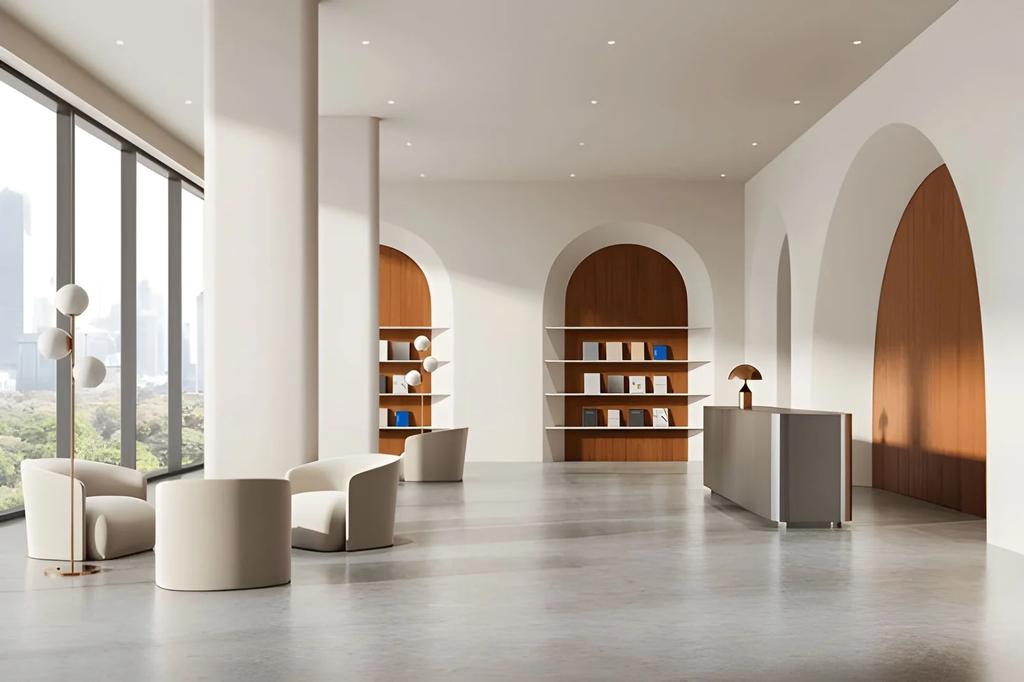
For most of the last thirty years, the dominant visual language of US residential design has been straight lines. Square rooms, rectangular windows, 90-degree corners, and the clean orthogonal geometry that contemporary construction makes easiest and most economical. It worked. It still works. But something has shifted noticeably in professional interior design practice over the last several years — a deliberate turn toward curves that’s showing up in architectural features, furniture choices, and the design philosophy of some of the most respected residential designers working in the US today.
Curved architecture isn’t new. Arched doorways, barrel ceilings, and curved staircases have appeared in residential design across centuries and cultures. What’s new is the intentionality with which contemporary designers are reintroducing curves — not as decorative flourishes on otherwise rectilinear buildings but as structural and spatial design tools that shape how people move through and experience their homes.
This article covers exactly how interior designers use curved architecture: the psychological effects curves produce, which architectural elements benefit most from curved treatment, how curves interact with contemporary furniture and materials, and what US homeowners should understand before incorporating curves into their own spaces.
Why Curved Architecture Produces Different Spatial Experiences Than Straight Lines
The difference between a curved architectural element and its straight-line equivalent isn’t purely visual — it’s psychological. Research in environmental psychology and neuroarchitecture has documented consistent differences in how the human brain responds to curved versus angular environments.
A landmark 2013 study published in the Proceedings of the National Academy of Sciences found that curved interior spaces were rated as more beautiful and elicited higher aesthetic pleasure responses than rectilinear spaces with matched content. Neuroscientist Anjan Chatterjee’s research at the University of Pennsylvania found that pointed, angular elements activated amygdala responses associated with threat perception, while curved elements produced no such activation. The implication: curves make people feel safer, more at ease, and more emotionally open in a space.
| Architectural Element | Straight-Line Effect | Curved Architecture Effect |
|---|---|---|
| Doorways and passages | Defined entry/exit points, clear boundaries | Softer transition, invitation rather than threshold |
| Walls | Room definition, clear corners | Spatial flow, rooms blend rather than terminate |
| Ceilings | Visual flatness or angle emphasis | Movement and height variation, sky-like quality |
| Staircases | Efficient vertical movement | Journey quality, sculptural centerpiece |
| Windows | Functional light aperture | Focal element, view framing, light modulation |
| Built-in furniture | Storage or function, rectilinear | Integration with architecture, organic quality |
Where Interior Designers Apply Curved Architecture Most Effectively
Arched Doorways and Passageways
The arched opening is the most accessible and most consistently effective curved architecture application in US residential design. It softens the transition between rooms — replacing the hard, defined threshold of a square doorway with a passage that invites rather than announces.
In practical terms, an arched doorway doesn’t change the room’s function; it changes how movement between rooms feels. Walking through an arched opening produces a qualitatively different experience from walking through a square one — there’s a subtle sense of entering a different environment rather than simply crossing a line. Professional designers use this quality deliberately: arched openings between a neutral hallway and a more intimate living space, or between a kitchen and a dining room, create transitions that feel considered rather than arbitrary.
The construction reality: converting a square doorway opening to an arch requires removing existing header materials and rebuilding with a curved form — a moderate renovation project ($500 to $2,500 depending on scope) but not a structural engineering challenge in most US residential applications.
| Arch Type | Visual Character | Best Application | Approximate Cost |
|---|---|---|---|
| Full semicircle arch | Classic, formal, strong statement | Entry halls, dining rooms | $800–$2,500 |
| Segmental arch (shallow curve) | Contemporary, subtle, refined | Between living spaces, kitchen to dining | $500–$1,500 |
| Pointed arch | Gothic influence, dramatic | Accent only — very specific aesthetic | $600–$2,000 |
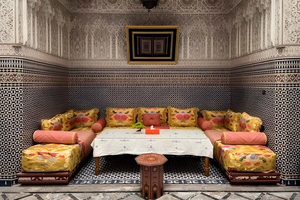
| Horseshoe arch | Moroccan influence, bold | Specific design directions only | $700–$2,000 |
| Irregular organic curve | Contemporary sculptural | Feature walls, built-in niches | $600–$2,000 |
Curved Walls and Niche Details
Full curved walls are the most architecturally ambitious curved architecture application and the one with the highest spatial impact — because a curved wall doesn’t just look different, it changes how a room functions spatially. A curved wall in a living room creates a gathering quality — the slight enclosure that curved surfaces produce encourages people to orient toward the concave side, which is exactly the quality that makes conversation spaces comfortable.
Designers most commonly introduce curved walls through: curved built-in shelving that follows the wall’s natural plane, a curved partition wall separating open-plan zones without fully enclosing them, or curved niches that create display or functional recesses in otherwise flat walls.
The curved niche is particularly accessible: a recessed curved niche in a flat wall, sized for a plant, a sculpture, or a lighting element, costs $200 to $800 to create and introduces the organic quality of curved architecture without structural changes to the room.
Curved Ceilings: The Most Underused Application
Barrel vaults, domed ceilings, and curved ceiling planes are among the most powerful curved architecture tools available — and among the least-used in contemporary US residential design, primarily because they’re associated with historic architecture and assumed to be expensive or inappropriate for modern homes.
Contemporary designers are challenging this assumption. A curved plaster ceiling in a simple, smooth contemporary finish reads as sculptural and modern rather than traditional. A barrel vault in a hallway transforms an otherwise transitional space into one of the most memorable moments in the home. A domed ceiling in a small reading room or study creates an intimate, focused environment that flat ceilings can’t produce.
The psychological effect of curved ceilings is distinct from other curved architecture applications: they create a sense of shelter and enclosure from above that flat ceilings don’t provide, triggering the same neurological response associated with natural shelters — caves, tree canopies — that humans evolved to find protective and comfortable.
How Curved Architecture Interacts With Furniture and Materials
One of the most practically significant considerations when incorporating curved architecture into a US home is how the architectural curves relate to the furniture within the space. Straight-lined furniture in a curved room can feel either deliberately contrasting (which works when the contrast is managed) or simply mismatched (which doesn’t).
| Curved Architecture Element | Furniture Response | Material Pairing |
|---|---|---|
| Arched doorways | Any furniture — arches are background | Natural materials amplify softness |
| Curved accent wall | Rounded furniture amplifies — angular contrasts | Plaster, limewash, organic textures |
| Barrel vault ceiling | Low-profile furniture — let ceiling dominate | Warm wood tones, linen, stone |
| Curved built-in shelving | Matching curve in decorative objects | Ceramic, organic forms, wood objects |
| Curved staircase | Furniture responds to staircase’s color, not form | Metal handrail details carried into fixtures |
| Curved partition wall | Seating oriented to concave side | Upholstered pieces, soft textiles |
The material relationship is equally important: curved architecture typically benefits from materials that have their own organic quality — plaster with visible texture, limewash with tonal variation, raw concrete with surface character. These materials emphasize the handmade, organic quality that curves suggest. Highly reflective, perfectly uniform materials (polished chrome, high-gloss white) can work in contrast but require careful management.
Curved Architecture Without Structural Changes: Furniture and Accessory Applications
For US homeowners who can’t or don’t want to undertake architectural modification, the principles of curved architecture can be introduced through furniture selection and accessory choices that produce many of the same psychological effects at significantly lower cost and commitment.
| Non-Structural Curved Element | Curved Architecture Effect It Mimics | Cost Range |
|---|---|---|
| Curved sofa (banana or curved form) | Gathering quality of curved walls | $800–$4,000 |
| Round dining table | Inclusive, democratic seating — no head | $300–$2,000 |
| Arched mirror | Arch framing without structural work | $80–$500 |
| Oval or round coffee table | Softens angular room, improves traffic flow | $150–$800 |
| Curved bookcase | Organic quality of curved built-ins | $200–$1,200 |
| Rounded area rug | Softens rectilinear furniture grouping | $100–$600 |
The arched mirror deserves particular attention: it’s the single most accessible way to introduce curved architecture vocabulary into any room, at any budget, with no installation beyond wall mounting. An arched mirror in an otherwise rectilinear room creates an immediate focal point that references architectural curves without requiring any structural work.
Frequently Asked Questions
What is curved architecture and why is it trending in US home design?
Curved architecture refers to the use of non-rectilinear forms — arches, curved walls, barrel vaults, rounded built-ins — in residential interiors. Its current prominence in US design reflects both a reaction to decades of strictly rectilinear contemporary design and a growing body of neuroarchitecture research showing that curved environments produce measurable positive psychological responses compared to angular ones. The trend is also driven by advances in digital fabrication that make custom curved elements more accessible than they were when everything required handcraft.
Are curved walls and arched openings only appropriate for certain architectural styles?
No — curved architecture works across styles when applied with appropriate material and detail choices. A smooth plaster arch with no ornamental detail reads as contemporary. The same arch with carved stone detailing reads as classical. The curve itself is style-neutral; the material and surface treatment determine the style context. This is why contemporary minimalist designers and traditional classical designers both use arches — they’re applying the same form with different material vocabularies.
Do curved architectural elements work in small rooms?
Often better than in large ones. Curved architecture in small rooms — particularly arched openings and curved ceilings — creates an intimate, sheltered quality that small rectilinear rooms struggle to achieve. A small study with a barrel vault ceiling feels like a refuge; the same room with a flat ceiling feels merely small. The enclosure quality that curves produce is particularly valuable in compact spaces.
What’s the most cost-effective way to introduce curved architecture into a US home?
An arched doorway opening or niche conversion. This is a moderate renovation project rather than a structural engineering challenge in most US residential applications, costs $500 to $2,500 depending on scope, and produces one of the most significant spatial experience changes available at that price point. The alternative — an arched mirror — introduces the vocabulary at any budget but without the architectural permanence.
How do I know if curved architecture will suit my home’s existing style?
The question to ask is whether the curve will be introduced as a deliberate contrast or as a continuation of existing forms. Both work: a contemporary home with one softly curved wall reads the curve as a deliberate design decision. A traditional home with arched openings reads them as continuation of historical architectural vocabulary. The mismatch to avoid is introducing curves as decoration without design intent — a curved mirror in an otherwise unaddressed room doesn’t produce the same spatial effect as curved architecture integrated into the room’s structure and flow.
The Bottom Line
Curved architecture gives designers a tool that straight lines can’t provide: the ability to shape how people feel in a space at a neurological level, not just a visual one. Arched openings soften transitions. Curved walls create gathering qualities. Barrel vaults produce shelter and intimacy. The effects are real, documented, and reproducible.
For US homeowners, the entry points range from the fully architectural (arched doorway conversions, curved partition walls) to the entirely furniture-based (curved sofa, round dining table, arched mirror). The principles behind all of them are the same: introducing organic, non-rectilinear forms into a space changes how the space feels to everyone in it — in ways that most people can experience but few can immediately explain.
Must visit https://designmode24.co/ for curved architecture interior designs.