 Jessica
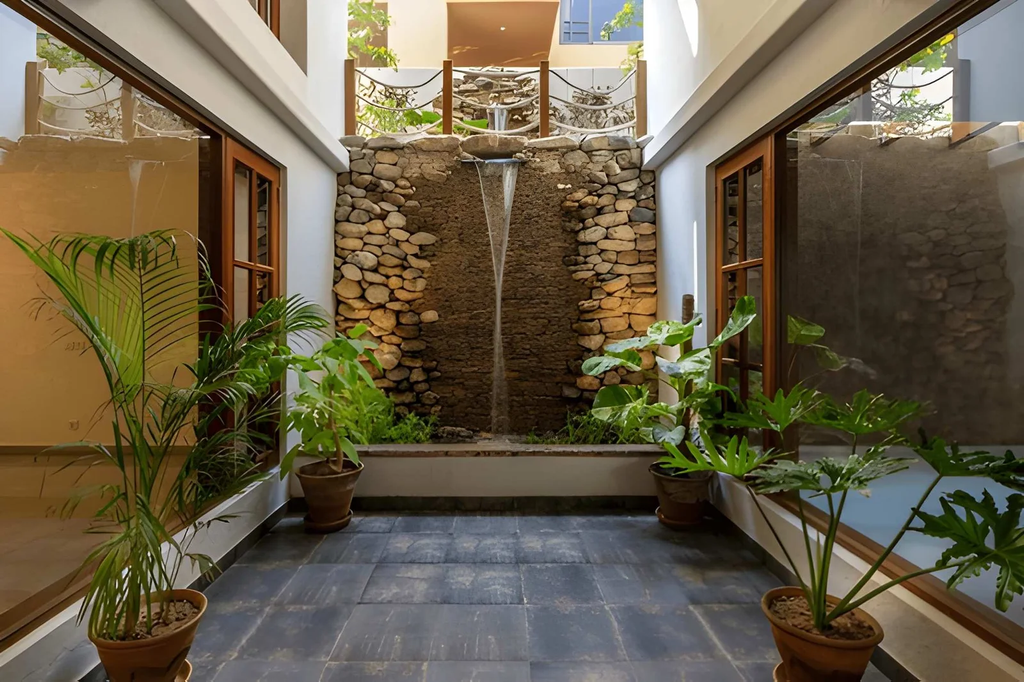
Water has been used in interior design for thousands of years — from the atrium fountains of ancient Rome to the courtyard water features of Islamic architecture to the minimalist stone basins of Japanese teahouses. Each tradition understood something that contemporary residential design is rediscovering: the presence of moving water in an interior space changes the experience of that space in ways that visual elements alone cannot achieve.
Indoor water features are experiencing significant revival in US residential design after decades of being associated primarily with commercial lobbies and high-end hospitality. The reasons are multiple — growing interest in biophilic design, the acoustic benefits that water provides in urban homes, increased attention to the sensory dimensions of domestic space, and a design culture that’s increasingly willing to look outside contemporary minimalism for inspiration.
But incorporating indoor water features well — in a way that enhances a space rather than creating maintenance burdens or visual imbalance — requires understanding how designers think about them: as sensory anchors, acoustic tools, focal points, and humidity regulators, not simply as decorative novelties. This article covers exactly how that thinking works and how US homeowners can apply it.
Why Interior Designers Use Indoor Water Features
The decision to incorporate indoor water features in a design project isn’t typically aesthetic first — it’s sensory and atmospheric. Water in an interior space affects the environment in multiple dimensions simultaneously, which is why its design value exceeds what its visual contribution alone suggests.
| Dimension | Effect of Indoor Water Features | Research Basis |
|---|---|---|
| Sound | White noise masking — reduces traffic and mechanical noise intrusion | University of Exeter research on soundscape masking |
| Humidity | Increases relative humidity in dry climates and HVAC environments | Basic physics of evaporation from water surface |
| Psychological | Reduces anxiety markers — associated with natural water environments | Multiple studies in environmental psychology |
| Air quality | Negative ion generation from moving water — modest air quality benefit | Published in International Journal of Atmospheric Sciences |
| Thermal | Evaporative cooling effect — modest temperature reduction | Basic evaporative cooling physics |
| Visual | Focal point creation — movement draws and holds attention | Consistent across architectural and design theory |
| Social | Acoustic privacy — water sound masks conversation | Applied in restaurant and therapy contexts |
The sound dimension is particularly significant for US urban homeowners: indoor water features provide natural acoustic masking that reduces the intrusion of traffic noise, HVAC sounds, and general urban ambient noise in a way that’s far more pleasant than mechanical white noise machines. A wall fountain in a home office or bedroom doesn’t just look good — it actively changes the acoustic quality of the space.
How Designers Incorporate Indoor Water Features: The Main Approaches
Wall-Mounted Water Features: The Most Space-Efficient Design Integration
Wall-mounted indoor water features — panels of water running down a stone, glass, or metal surface — are the format most commonly used by interior designers in US residential projects because they provide maximum visual and acoustic presence within a minimal floor footprint.
The design logic: a wall feature reads as architectural rather than decorative when it’s correctly scaled to the wall it occupies and when its material relates to the room’s existing material palette. A slate water wall in a room with stone tile flooring reads as an extension of the architectural language. The same feature in a room with no other stone or natural material reads as an import from another design context.
Scale matters enormously for wall-mounted indoor water features. A feature that’s too small for its wall reads as an object placed on the wall rather than an architectural element — it has the decorative quality without the spatial presence. Designers typically specify features that occupy at least 40% of the wall width they’re on, which is significantly larger than most homeowners intuitively select.
| Wall Feature Material | Design Character | Best Room Pairing | Installation Complexity |
|---|---|---|---|
| Natural slate | Organic, grounding, timeless | Living room, entryway, spa bathroom | Medium — weight considerations |
| Polished granite | Contemporary, formal, reflective | Entry halls, dining rooms | Medium |
| Glass (with backlighting) | Dramatic, contemporary, luminous | Home offices, dining rooms | Medium-High — electrical |
| Stainless steel | Industrial, contemporary, sleek | Modern kitchens, contemporary interiors | Medium |
| Copper (aged) | Warm, organic, distinctive | Living rooms, meditation spaces | Medium |
| Corten steel | Industrial-organic, bold | Contemporary homes, loft apartments | Medium |
Freestanding Fountains: The Flexible Indoor Water Feature
Freestanding indoor water features offer flexibility that built-in or wall-mounted options don’t — they can be positioned where they’re most effective acoustically and visually, and they can be moved if the room’s use or design changes.
The design challenge with freestanding indoor water features is integration: because they’re not architecturally fixed, they require more careful consideration of how they relate to surrounding furniture, the floor surface they’re on, and the room’s overall composition. A freestanding fountain that looks like it was placed where it happened to fit reads as afterthought decoration. One that’s clearly positioned as a focal element — centered on an axis, flanked by related elements, or anchored by a defined material zone around its base — reads as designed.
Built-In Indoor Water Features: The Highest Design Integration
Built-in indoor water features — integrated into architectural walls, floors, or custom furniture elements — represent the highest level of design commitment and produce the most seamless spatial results. A recessed floor channel with water flowing between interior and exterior spaces, a water wall integrated flush with a fireplace wall, or a shallow reflection pool in an entryway floor: these features are inseparable from the architecture and read as part of the building’s design vocabulary.
Built-in features require planning at the design or renovation stage — they involve plumbing, drainage, and often structural considerations that can’t be added after construction without significant disruption. For US homeowners considering a renovation, incorporating a built-in indoor water feature at the planning stage is far more cost-effective than attempting retrofit installation later.
Where Indoor Water Features Work Best in US Homes
| Room | Indoor Water Feature Application | Primary Benefit | Design Consideration |
|---|---|---|---|
| Entry hall | Wall panel or freestanding fountain | First impression, acoustic welcome | Must not impede traffic flow |
| Living room | Wall feature or architectural integration | Focal point, acoustic comfort | Scale to wall, material coherence |
| Home office | Tabletop or small wall feature | Acoustic privacy, focus support | Not too large — distraction risk |
| Primary bathroom/spa | Wall feature or floor pool | Resort quality, relaxation | Humidity management critical |
| Meditation/yoga room | Any format at appropriate scale | Sensory completeness, calm | Size relative to room |
| Dining room | Statement wall feature | Atmospheric, conversational | Sound level management |
| Courtyard (interior) | Central fountain or channel | Traditional application, dramatic | Access to drainage essential |
The Practical Considerations Designers Address First
The most common failure of amateur indoor water features attempts is insufficient attention to practical requirements before aesthetic decisions. Designers address these before specifying any feature:
Drainage and plumbing. Indoor water features recirculate water through a pump — they’re self-contained systems that don’t require connection to a drain for normal operation. However, maintenance access, pump replacement, and potential overflow situations all require that installation placement considers access and cleanup.
Electrical requirements. All functioning indoor water features require electrical power for the pump. The outlet location relative to the feature, the use of waterproof electrical components, and proper GFCI protection are all non-negotiable safety requirements. This is not a DIY electrical task — proper installation requires a licensed electrician.
Humidity management. Moving water increases indoor humidity. In US climates with high ambient humidity (Southeast, Gulf Coast), indoor water features can push humidity levels to mold-promoting ranges without adequate ventilation. In arid climates (Southwest, Mountain West), the additional humidity is typically beneficial. Assessing the climate context before specifying indoor water features is a basic due diligence step.
Maintenance access and commitment. Water features require regular cleaning to prevent algae growth, mineral deposit accumulation, and pump wear. A feature that’s difficult to access will be inconsistently maintained and will eventually read as neglected rather than designed. Ease of maintenance should be a selection criterion alongside aesthetics.
Frequently Asked Questions
Are indoor water features high maintenance?
Moderate — not dramatically high, but not zero. A well-designed recirculating water feature requires weekly water level checks, monthly cleaning of the basin and pump, and periodic descaling in hard water areas. A feature that’s easy to access takes 15 to 20 minutes monthly to maintain properly. Features that are difficult to access are harder to maintain and often show it. Maintenance ease should be factored into selection alongside aesthetics.
What size indoor water feature is right for a typical US living room?
For a wall-mounted feature, approximately 40 to 60% of the wall width is the proportional range that reads as architectural rather than decorative. In a 15-foot wide living room with an 8-foot high ceiling, a feature 5 to 6 feet wide and 5 to 6 feet tall is appropriately scaled. Homeowners typically underestimate the required size — features that look substantial in showrooms often disappear in actual room contexts.
Do indoor water features work in apartments?
Yes — with the caveat that built-in features requiring structural plumbing aren’t appropriate for rental or apartment situations. Freestanding and wall-mounted recirculating features that are self-contained (no drain connection required) work in any living situation and can be removed without leaving damage. The electrical requirement is the primary consideration — a nearby GFCI outlet is needed.
How much do indoor water features cost?
The range is extremely wide: tabletop models start at $50 to $150, quality freestanding features run $300 to $1,500, and custom wall-mounted or built-in features can range from $2,000 to $20,000 or more depending on size and material. The electrical installation cost (if a new outlet is needed) adds $150 to $400. For most US homeowners, a mid-range freestanding or wall-mounted feature in the $500 to $2,000 range represents the accessible entry point into indoor water features with genuine design presence.
Can indoor water features be used in bedrooms?
Yes — and the acoustic benefit is particularly valuable in bedrooms, where the water sound provides natural white noise that can improve sleep quality. The key consideration is sound level: features with gentler water sounds (a slow wall sheet rather than a splashing fountain) are better suited to sleeping environments. Humidity management is also important in enclosed bedroom spaces.
The Bottom Line
Indoor water features are being rediscovered in US residential design because they do something that purely visual design elements can’t: they change how a space sounds, feels, and breathes. The acoustic masking, humidity modification, psychological calming, and focal point creation that well-designed indoor water features provide represent a qualitative improvement in domestic space that goes beyond decoration.
The designer’s approach — addressing acoustic need, scale requirements, material coherence, practical maintenance, and electrical safety before aesthetic selection — produces features that are part of the space’s architecture rather than objects placed within it. US homeowners who apply the same thinking will find that indoor water features, chosen and placed correctly, transform the rooms they inhabit in ways that furniture and decoration alone never quite achieve.
Must visit https://designmode24.co/ for indoor water features.